
Mining From Somewhere Else: What a Phone Has to Prove
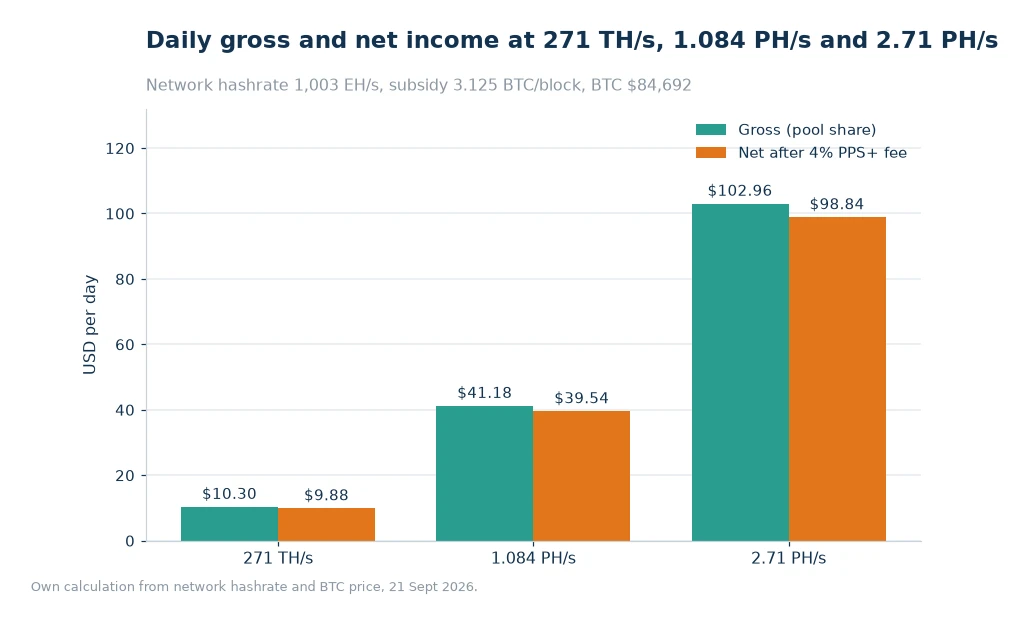
At 271 TH/s the pool credits about 0.00012159 BTC a day, $10.30 at $84,692, and $9.88 after the posted 4% on the block-reward piece. An operator who is not standing next to the machine has to trust a screen instead of a noise level. The screen is only useful if it answers three questions quickly: is it hashing, is it hot, and did the money arrive.
Key takeaways
- A silent failure is the expensive kind: four unnoticed hours at 271 TH/s cost about $1.65, a full day costs $9.88.
- Alert on hashrate, intake temperature and the absence of a credit, not on every share fluctuation.
- Keep the pool account separate from the machine's local login, so a lost phone does not mean a lost rig.
- Reconcile the app against the pool statement once a week; the two should agree on the same number of coins.
The room you are not in
Remote operation changes the failure modes rather than the arithmetic. A machine in the next room announces a failed fan with a noise you can hear from a doorway. The same machine three hundred kilometres away announces it by quietly losing hashrate, and the only way to notice is a number that stops matching yesterday's number.
The first job of remote monitoring is therefore not optimisation but detection. A rig that is hashing at 90% for a week because one board dropped out will still look healthy in a monthly total. It looks obviously wrong on a chart with a flat line that steps down one afternoon. That chart sits inside the ViaBTC Bitcoin Mining dashboard, which is worth a glance even on days when nothing appears to be wrong.
What an alert is actually for
Alerts are for events that need a decision within hours, not for events that can wait until Sunday. A temperature crossing a threshold at two in the morning qualifies, because the response might be to reduce load before damage. A single rejected share does not. An alerting system tuned too tight gets muted, and a muted system is worse than none because it creates false confidence.
Two alerts cover most of the risk at small scale: hashrate below a floor for more than fifteen minutes, and no new credit when one was expected. The first catches hardware and network problems. The second catches everything else, including a pool-side issue, a changed payout address, or a machine that is technically hashing but not submitting acceptable work.
271 TH/s, watched from three distances
There are three useful distances from the hardware, and each answers a different question. The machine's own interface answers whether the boards are alive. The pool dashboard answers whether the work is being accepted. The wallet answers whether the coins arrived. Confusing these three is how an operator spends an evening troubleshooting a machine that was fine all along.
At 271 TH/s the numbers are small enough to check by hand. A day of net output is 0.00011672 BTC. An hour is about 0.00000486 BTC. If the wallet shows a credit that is roughly four times the hourly figure, four hours have settled. If it shows nothing for half a day, something between the machine and the address needs looking at.
| What to watch | How often | Healthy reading | Act when |
|---|---|---|---|
| Reported hashrate | Every 15 minutes | Within 2% of 271 TH/s | Below 255 TH/s for an hour |
| Intake temperature | Hourly | Close to room ambient | More than 12°C above ambient |
| Rejected share rate | Daily | Under 1% | Above 2% for a day |
| Coins credited | Every 6 hours | About 0.00002918 BTC | Nothing in 12 hours |
The final row rarely gets configured, and it catches the most. Hardware alerts tell you the machine is unhappy. A credit alert tells you the business is unhappy, which is a different and more important signal.
When the app and the pool disagree
They will disagree, and usually for a boring reason. The app may show a rolling average while the pool shows a snapshot, or one may round to two decimals where the other keeps eight. Before assuming a fault, compare the same metric over the same window: the average hashrate for the last hour on both, or the credited coins for the last six hours on both.
A real disagreement looks different. If the machine reports 271 TH/s for a day and the pool credits the equivalent of 240 TH/s, work is being lost somewhere between the two, and the usual suspects are stale shares from a poor connection, a firmware setting, or a second worker name quietly hashing to the same account.
Access hygiene for a remote operator
A remote rig concentrates risk in a few credentials. The pool account password, the two-factor device, the machine's local login and the wallet address are the four things that matter. Losing any of them while travelling turns a manageable problem into a week of support tickets, so each should have a recovery path that does not depend on being in the same country as the hardware.
Two habits are worth the five minutes they take. Store the recovery codes somewhere that is not the phone, and write the payout address on paper in the same place. An address you can read out over a phone call is the difference between a quick fix and an unplanned trip.
The Sunday check that catches drift
Once a week, open three screens side by side and write one line: coins credited, average hashrate, power cost. That is the whole ritual. Over a quarter, the line becomes a series, and the series shows drift that no single day reveals: a slow decline in hashrate as filters clog, a slow rise in power as a supply ages, a step change after a firmware update.
The check takes ten minutes and replaces most of the anxiety of running hardware you cannot see. It also produces the record you will want when a machine is eventually sold, because a buyer trusts a log more than a claim.
Worked example: the cost of not noticing
Start from the daily credit and divide down to the cost of an unattended failure.
- 450 BTC ÷ 1,003,000,000 TH/s = 0.00000044865 BTC per TH/s a day.
- 271 × 0.00000044865 = 0.00012159 BTC, or $10.30 at $84,692.
- After the 4% block-reward charge: 0.00012159 × 0.96 = 0.00011672 BTC, or $9.88.
- Per hour: 9.88 ÷ 24 = $0.41.
- Four hours of silence: 4 × 0.41 = $1.65.
- One day before anyone notices: $9.88, which is 0.00011672 BTC that never arrives.
- A weekly check that catches the fault after two days instead of seven saves $49.40.
Frequently asked questions
What should I monitor first on a remote rig?
Credited coins, because that single number captures hardware, network and pool problems at once; at 271 TH/s roughly 0.00002918 BTC should appear every six hours at $84,692.
How much does an unnoticed outage cost?
About $0.41 an hour at this hashrate, so four hours is $1.65 and a full day without hashing is $9.88 of credit that will not be recovered.
Is a temperature alert necessary in a cool climate?
Yes, because the risk is a fan or filter failure rather than the weather; an intake more than 12°C above room ambient means airflow has changed and the machine may begin throttling.
Set the alerts before the next trip
Configure the two that matter, test them by lowering the threshold for a minute, and then leave them alone. The ViaBTC App puts hashrate and credit alerts on the same phone you would use to check a flight, and the pool state page tells you whether a dip is yours or everyone's. A remote rig is not more fragile than a local one; it is just quieter when it breaks.
Sources: ViaBTC app, pool state and pricing pages, with chain data read 21 Sept 2026 — network hashrate 1,003 EH/s, difficulty 132.76 T, 3.125 BTC per block, 144 blocks a day, BTC $84,692. Threshold values are suggestions for this hashrate. Published 24 Oct 2026[1].